
Cleaner Energy Solutions (CES) Perspective: Fortune Op-Ed Highlights the Real Issue — Our Broken Grid, Not Data Centers
By Cleaner Energy Solutions Staff
Published March 31, 2026
As lawmakers from both parties advance legislation aimed at protecting consumers from rising electricity costs tied to data centers, a compelling op-ed published in Fortune argues that these facilities are not the core problem. Instead, the real culprit is a decades-old, underbuilt grid struggling to keep pace with modern demands. This debate underscores a critical tension: should regulations zero in on data centers, or address the broader infrastructure challenges that power everything from AI innovation to everyday American life?
A Wave of Bills Targets Data Centers
The legislative momentum built throughout early 2026. In January, Senator Chris Van Hollen introduced the Power for the People Act, directing states to establish special rate classes for data centers and tasking the Federal Energy Regulatory Commission with ensuring these facilities cover the costs of local transmission upgrades. “The huge corporations building and running data centers should cover the costs of the energy they need — not push those costs onto the backs of consumers,” Van Hollen stated.
In February, Senators Josh Hawley and Richard Blumenthal introduced the bipartisan GRID Act, which requires new data centers exceeding 20 megawatts to source power entirely outside the existing grid, with a 10-year transition period for current facilities. Most recently, Senator Bernie Sanders and Representative Alexandria Ocasio-Cortez proposed legislation to pause new data center construction altogether until stronger safeguards are in place.
The drivers are evident: Lawrence Berkeley National Laboratory projects data centers could account for up to 12% of U.S. electricity demand by 2028. PJM Interconnection, the largest U.S. grid operator, has witnessed capacity prices jump dramatically — from $28.92 per megawatt-day (2024–2025) to $329.17 (2026–2027).
The “Broken Grid” Counterargument
In the Fortune op-ed titled “Data centers aren’t breaking the grid. A broken grid is,” Brian Barlow, CEO of Sidewalk Infrastructure Partners, contends that data centers, electric vehicles, heat pumps, and industrial electrification are simply exposing long-standing weaknesses in outdated infrastructure. Rather than restricting growth, the focus should be on building a more resilient, flexible system.
Supporting research reinforces the value of smart solutions over blunt restrictions. A Duke University study indicates the U.S. grid holds more than 100 gigawatts of potential headroom for new loads when data centers operate flexibly — shifting consumption in time and location. A follow-up analysis showed that making just 20% of data center demand flexible could reduce the need for new natural gas plants by nearly 20%. At CERAWeek in Houston, Nvidia and Emerald AI partnered with utilities like AES, Constellation Energy, and NextEra Energy to develop “flexible AI factories” that can ramp power up or down during periods of grid stress.
Climate Goals Under Strain
Meanwhile, the environmental impacts of the AI expansion remain a pressing concern. An Associated Press report revealed that, despite ambitious clean energy procurement, major tech companies have seen emissions rise during the initial years of their climate commitments — Google by nearly 50%, Amazon by 33%, Microsoft by over 23%, and Meta by more than 60%. The Rhodium Group estimated a 2.4% increase in U.S. greenhouse gas emissions in 2025, partly fueled by data center demand that drove coal generation up 13%. Julie McNamara of the Union of Concerned Scientists described the surge in data center electricity use as turning a manageable challenge into “an outright crisis.”
Cleaner Energy Solutions: Delivering Carbon-Zero, Resilient Power for the AI Era
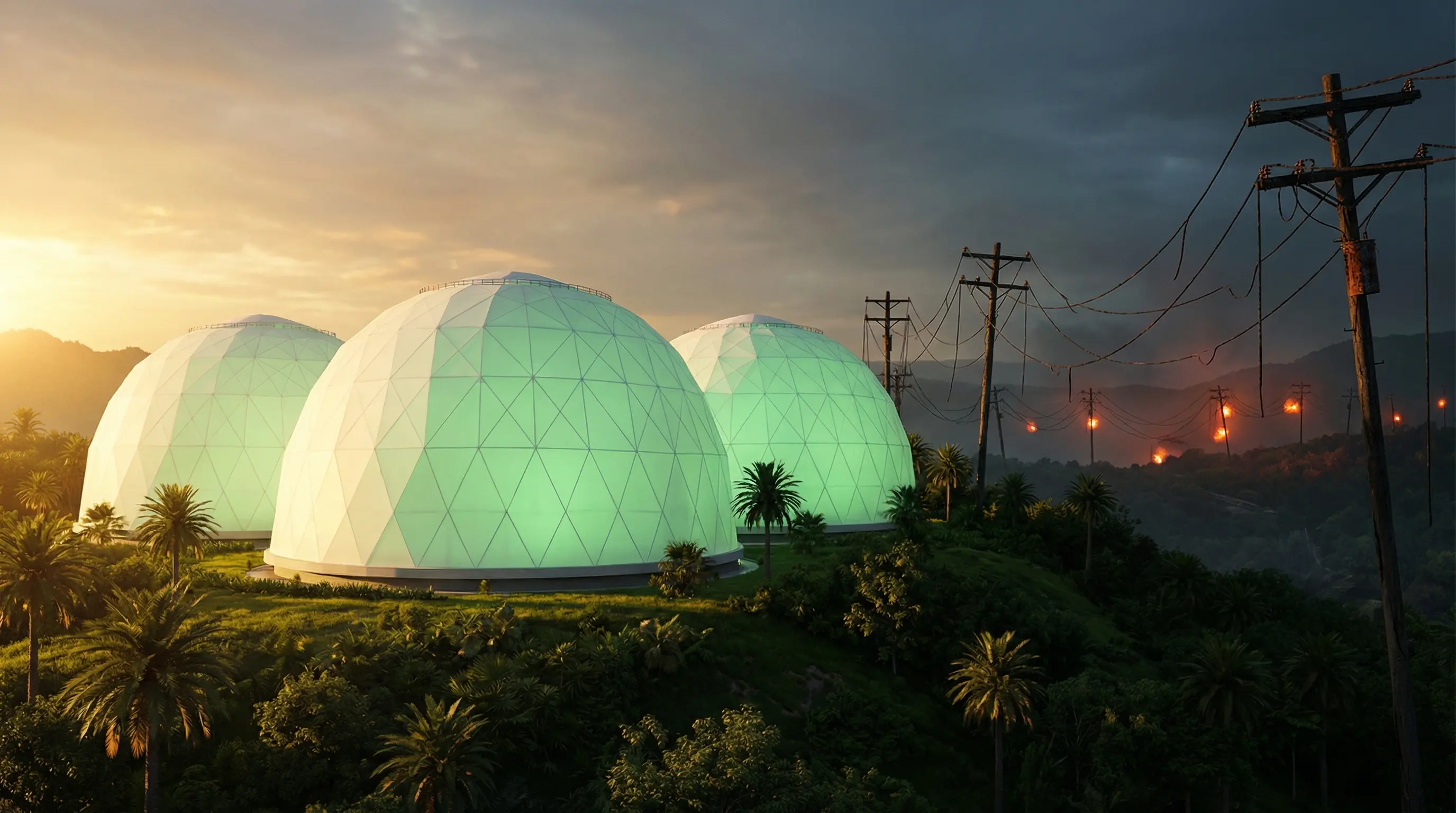
At Cleaner Energy Solutions (CES), we see this not as a crisis to restrict, but as an opportunity to transform. Our innovative Small Modular Reactor (SMR) technology — housed in sleek, hurricane- and earthquake-resilient ellipsoid domes — provides carbon-zero, scalable energy with a minimal footprint. Each SMR module from Westinghouse and GE delivers up to 300 MW, fully self-contained with reactor, steam turbine, and generator, separated by up to 3 feet of reinforced concrete for maximum safety.
Inspired by efficient “Dell computer”-style modularity and principles of rapid scaling, CES domes allow utilities, data centers, and communities to add capacity seamlessly: 300 MW today, 600 MW or 900 MW tomorrow. Designed for sites like San Germán, Arecibo, and Morovis in Puerto Rico — and aligned with the Trump administration’s push for domestic nuclear energy independence under the Nuclear Energy Innovation and Modernization Act — our solutions directly address the broken grid by delivering clean, reliable, dispatchable power without reliance on intermittent sources or aging fossil infrastructure.
By partnering with forward-thinking operators (including potential collaborations with AWS, Tesla, and utilities), CES enables flexible, on-site or near-site generation that reduces strain on the legacy grid, cuts emissions, and supports AI-driven growth while keeping consumer rates stable. This is the practical path forward: not pausing progress, but powering it with advanced, resilient nuclear innovation that meets rising demand, strengthens energy security, and advances global sustainability goals.
Cleaner Energy Solutions is ready to help utilities and data center developers build the future — one resilient dome at a time. Contact us to explore how our SMR technology can secure reliable, carbon-zero power for your needs.